Poe's stance on the poetic principle needs to be set up in contrast (almost in one's preconscious or out of the corner of the eye, so to speak) with the writings of two of his most poetic contemporaries. I refer to Shelley and Keats. While I totally disagree with the opinion of Empson's nasty and dismissive, assertion as to Poe's poetry providing evidence of his smoking peyote, he is certainly correct in his evaluation of Shelley and Keats. (Sadly, Empson seemed to be inflicted with the intellectual virus of kowtowing to existential modern muck. This is to be seen clearly in his adulation of T.S Eliot and echoing of Henry James.)
Shelley's ideal that poets are the true legislators of the world might, one supposes, stand as an instance of what Poe derides as didacticism. However, Shelley's poems have no tarnish of the dogmatic about them. Contrast them in your mind's eye, if you will, with those rather blistering and truly didactic verses of John Donne.
Keats' usage of the writings on melancholy of Burton, on the other hand do comport with Poe's principle of poetic sentiment. None other than the towering figure of Ibn Sina wrote as much centuries earlier when he wrote of the soul's metaphorical condition as a forlorn wish to be able to soar as a bird. This thought if properly teased out inexorably leads us to Leonardo's quest and today's extra terrestrial imperative as much as Shelley's skylark.
Which is to agree with Edgar that for the common prosaic soul (or should I have ventured to say commoner here, dear reader?) the didactic 'sdeath, so to speak. But the exceptions (and most ironically Mr. Poe is one of them) are the soul of true poesy, as Keats would have it in his ode to a Grecian urn.
To explain, Poe was and always will be himself most thoroughly a patriotic American scientist willy-nilly. As was Shelley. But not of the sort of the proverbial Yankee ingenuity lampooned by Twain. In fact, Poe's war with what he the Boston Brahmin frogpondians is instructive and to the point here.
Poe is a scientific detective into the political motives of such as Disraeli, Young America's Margaret Fuller, and the bilge of poetaster Pre-pre-Raphaelite Thomas Carlyle. Which is to say, there is a moral hazard in taking the politics out of Poe. For instance, the correspondence and quite uncharming embrace of Margaret Fuller with Mazzini's Young Europe gets us rather immediately to the kernel of Poe's patriotic detective work. (And let it not go unsaid that it is most unfortunate that Paulding seemed to have been turned against Poe.) The overriding point being that the same Young American political outfit were supporters of the confederacy, i.e. pawns of Lord Palmerston's unholy political zoo of movements and isms.
While Poe is absolutely correct in his aspersions cast against the quite evil Francis Bacon, Martin Van Buren, and Andrew Jackson, he was nonetheless unfortunately taken in by the hoax of the greatness of Sir Isaac Newton and Pierre-Simon Laplace. One does wonder if he had lived would he have come to know the ageless genius of Leibniz and have realized his error, similarly to Shelley's conversion via Raphael Sanzio. (Although Poe did refer to Leibniz in reverential terms as the great "master.")
If you understand the foregoing, dear reader then it should not shock you that Poe was vilified for his potential that he threatened in his modus of debunking the politics of America's literati and their desire to return us to mother (as in MI5) England. This is the apparatus that carried out the hatchet job against both Keats and Poe.
P.S. I ran into a rather nasty patch of this type of skulduggery while investigation the literary association of an ancestor of mine: John Curtis Chamberlain. Poe's satire of the Folio Club is instructive here. For it turns out that he was a Harvard educated lawyer in a certain literary circle headed by an obscure Harvard publisher by the name of Joseph Dennie. In particular, Dennie's dismissal of Leibniz in one of letters while attending Harvard, stuck in my craw. For my experience at the University of Buffalo when introduced to Leibniz' Monadology was rather like Keats' metaphor of wild surmise. That is, I was as if thunderstruck by Leibniz thoroughly principled use of the Socratic absolute negation in his irrefutable theodicy. How the anglophilic Dennie could wave Leibniz off as stuffy and boring evinces a clear instance of what Schiller might have referred to as the soul of a mere bread learner masquerading as a lover of the arts. But the issue of Leibniz versus Newton was a sort of intellectual puntum saliens of the those days. (Dennie appears later to have somewhat come to his senses via his publishing association with John Quincy Adams in Philadelphia.) The cult of Newton worship is a more powerful weapon in a certain sense in the hands of MI5's Bertrand Lord Russell than was his openly evil avowed desideratum to bomb the Russians previous to their having developed the hydrogen bomb.

Today's Elites
Showing posts sorted by relevance for query keats. Sort by date Show all posts
Showing posts sorted by relevance for query keats. Sort by date Show all posts
Sunday, June 05, 2011


Saturday, January 07, 2012
Why Rembrandt Like Keats Understood The Ironic Beyond the Grave
Viewing the really marvelous (magnifiable) National Gallery online Ecce Homo by Rembrandt, it is evident that his genius for espousing truth is his only motivation in this piece. For he took a subject that had been part of the regular pantheon of traditional artistry and ironically elevated it to a commentary against the oligarchy then ruling the Netherlands, soon to be inflicted upon Britain and of course the world.

The bust of the Emperor hovers over the staged scene. What irony is here just in that very arrangement. It is not Pilate or the Hebrew audience whence the order is given for the crucifixion, it is Rome! (Or perhaps, better yet, the Isle of Capri.)
The bust of Homer is just as ironic, yet in a different way. And this is the nature of multiple levels of irony known only to the genius of poetic truth. But irony is not mere pedestrian stuff. For it is clear as day that Homer's bust can "see"-- from the light exudes from him. Just as it ironically does in his Philosophe Lisant, the life of Christ etchings and needless to say the ever quite literally optically moving self portraits. Yet Aristotle is evidently utterly blind though he claims that the senses are all. For Rembrandt knew the nature of precisely what lives on beyond the grave...He knew how to "cap the imagination" of supposed kings and like Keats could well have written lines like these- were he not primarily a composer in paint:
The living hand, now warm and capable
Of earnest grasping, would, if it were cold
And in the icy silence of the tomb,
So haunt thy days and chill thy dreaming nights
That thou wouldst wish thine own heart dry of blood
So in my veins red life might stream again,
And thou be conscience-calmed--see here it is--
I hold it towards you.
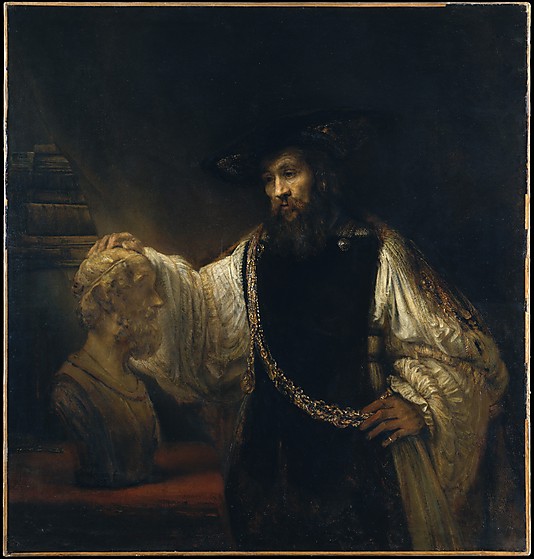


(Compare Bosch's great Ecce Homo)
The bust of the Emperor hovers over the staged scene. What irony is here just in that very arrangement. It is not Pilate or the Hebrew audience whence the order is given for the crucifixion, it is Rome! (Or perhaps, better yet, the Isle of Capri.)
The bust of Homer is just as ironic, yet in a different way. And this is the nature of multiple levels of irony known only to the genius of poetic truth. But irony is not mere pedestrian stuff. For it is clear as day that Homer's bust can "see"-- from the light exudes from him. Just as it ironically does in his Philosophe Lisant, the life of Christ etchings and needless to say the ever quite literally optically moving self portraits. Yet Aristotle is evidently utterly blind though he claims that the senses are all. For Rembrandt knew the nature of precisely what lives on beyond the grave...He knew how to "cap the imagination" of supposed kings and like Keats could well have written lines like these- were he not primarily a composer in paint:
The living hand, now warm and capable
Of earnest grasping, would, if it were cold
And in the icy silence of the tomb,
So haunt thy days and chill thy dreaming nights
That thou wouldst wish thine own heart dry of blood
So in my veins red life might stream again,
And thou be conscience-calmed--see here it is--
I hold it towards you.
Saturday, January 14, 2012
Newton's Alchemy Apologists Unmasked
The discovery by Keynes that Isaac Newton was a dedicated kook in extremis is always rather blithely dismissed by his adulators with a wink by the pat formula that they were all doing magic nonsense back then. Hmm...really? Was Newton's adversary Leibniz a benighted necromancer as well? Hardly. In fact, read his point by point refutation of John Locke's "Essay Concerning Human Understanding" and you will find just the very opposite.
On the other hand, if you have the stomach to read the lengthy tome The Anatomy Of Melancholy by Robert Burton, you will laugh at all sorts of malarkey about magic stone cures, Rosicrucianism and witchery ad nauseum. See Keats Eve of St Agnes. Rather like the new age kookery from the hippies decades ago. Did you know that Edmund Spencer's Fairie Queene was inspired by Kabalistic magic, and that Shakespeare's Merchant of Venice scene of the choosing of the caskets is right out of the Cabalistic legerdemain. The marriage counselor of Henry VIII was the Venetian Cabalistic monk Giorgi, aka Zorzi (he read auras.)
Leibniz attacked Newton's magical belief that the universe was set into motion by a fatherly clock maker who must then stand back and impotently watch the entropic magical action at a distance mayhem ensue. Descartes' momentum he proved is not equivalent to force. Descartes and later Grassman's vision of a manifold of empty space where we can only describe an algebra that locates mere dead points. The very belief today that according to the much worshiped Second Law of Thermodynamics humanity is doomed to run out of energy and that technology is evil is the epitome of cultish kookery today centered where? In the "British" monarchy's Worldwide Fund for Nature (which really isn't English at all, Leibniz in fact would have been prime minister, in effect, for the Electress of Hanover, Sophie Charlotte upon her succession, had she lived) --that's where! So now Greenpeace and green this and green that and earth this and earth that are called science. Gaia worship is all it is. The same crowd that subverted Vernadsky's rigorous evolutionary concept of Noosphere Teilhard de Chardin. The same lunacy of the futurologists singularity Omega point garbage that wag Newt Gingrich's mouth. And who pray tell was the biggest addicted opium eater (laudanum back then) of them all old boy? Queen Victoria that's who.
Saturday, September 10, 2011
Why The Muse Eludes Even The Well Intentioned
William Empson's Seven Types of Ambiguity displays a rare talent for ferreting out metaphorical irony in Keats, Shakespeare, and especially Shelley, who he fully "got." It is a downright shame though that he swallows whole hog the poppycock that Poe was some sort of peyote eating lunatic a la Aleister Crowley. In fact, Poe spent his literary life exposing just such charlatans. The idea that his verse is mere surface and just so much pretty (or noxious) noise (here Empson cynically shoves The Bells at us as proof) is fallacious.
Poe realized that the Boston Brahmin "frogpondians" were engaged in a mission to betray the purpose of America's founding. This he stated over and again in a myriad of ways throughout his works. (Empson's praise for T.S. Elliot is significant in this regard.) The mystical and mellifluous babble of these would be transcendentalists is nowhere exhibited more perfectly than from the prose of one Amos Bronson Alcott. To wit:
"Nature is quick with spirit. In eternal systole and diastole, the living tides course gladly along, incarnating organ and vessel in their mystic flow. Let her pulsations for a moment pause on their errands, and creation's self ebbs instantly into chaos and invisibility again. The visible world is the extremist wave of that spiritual flood, whose flux is life, whose reflux death, efflux thought, and conflux light. Organization is the confine of incarnation,—body the atomy of God."
Alcott's, like his admirer Thoreau's, Utopian fiascoes were part and parcel of the British sponsored anti-science irrationality imported by way of Calcutta, among other haunts of their opium trade. (Of which the Boston blue blood merchant vessels of the Lowells, et al. enjoyed their fair share as Tory sympathizers.) It is this inane type of twaddle that Poe so artfully excoriates in "The System of Doctor Tarr and Professor Fether," for instance. Poe's criticism is continually aimed at routing out and ridiculing this very sort of non sense for the American reading public. This is the same sort of behaviorist and deconstructionist rot that the American Psychological Association's style book of symbolic mysticism imposes on our woe betid students today.
So what was the "hidden metaphor" in poems like Annabelle Lee, that Empson, and his ilk, couldn't appreciate? What but the very soul of beauty under attack here upon these American shores...
Tuesday, December 29, 2015
What Makes an Elite? A Reflection upon Immortality.
If the mind and soul is concentrated and oriented upon a mission to afford future generations a creative spark then this equates to a true character of happiness. And this is an uplifting quality which we all have in potential as uniquely human. That is the essence of our equality. In this way the ending of the Keats poem Ode on a Grecian Urn rings a clarion trumpet.:
Thou still unravish'd bride of quietness,
Thou foster-child of silence and slow time,
Sylvan historian, who canst thus express
A flowery tale more sweetly than our rhyme:
What leaf-fring'd legend haunts about thy shape
Of deities or mortals, or of both,
In Tempe or the dales of Arcady?
What men or gods are these? What maidens loth?
What mad pursuit? What struggle to escape?
What pipes and timbrels? What wild ecstasy?
Heard melodies are sweet, but those unheard
Are sweeter; therefore, ye soft pipes, play on;
Not to the sensual ear, but, more endear'd,
Pipe to the spirit ditties of no tone:
Fair youth, beneath the trees, thou canst not leave
Thy song, nor ever can those trees be bare;
Bold Lover, never, never canst thou kiss,
Though winning near the goal yet, do not grieve;
She cannot fade, though thou hast not thy bliss,
For ever wilt thou love, and she be fair!
Ah, happy, happy boughs! that cannot shed
Your leaves, nor ever bid the Spring adieu;
And, happy melodist, unwearied,
For ever piping songs for ever new;
More happy love! more happy, happy love!
For ever warm and still to be enjoy'd,
For ever panting, and for ever young;
All breathing human passion far above,
That leaves a heart high-sorrowful and cloy'd,
A burning forehead, and a parching tongue.
Who are these coming to the sacrifice?
To what green altar, O mysterious priest,
Lead'st thou that heifer lowing at the skies,
And all her silken flanks with garlands drest?
What little town by river or sea shore,
Or mountain-built with peaceful citadel,
Is emptied of this folk, this pious morn?
And, little town, thy streets for evermore
Will silent be; and not a soul to tell
Why thou art desolate, can e'er return.
O Attic shape! Fair attitude! with brede
Of marble men and maidens overwrought,
With forest branches and the trodden weed;
Thou, silent form, dost tease us out of thought
As doth eternity: Cold Pastoral!
When old age shall this generation waste,
Thou shalt remain, in midst of other woe
Than ours, a friend to man, to whom thou say'st,
"Beauty is truth, truth beauty,—that is all
Ye know on earth, and all ye need to know."


Saturday, October 22, 2016
How the Poetic Faculty of Hypothesis Overcomes Limits of Human Senses
A result of the fact that human creativity is capable of scientific revolutions is the extension of our very limited mammalian senses into the much broader electromagnetic spectrum. It is the case that we now know that many species are capable of sensing parts of that spectrum walled off from human sense perceptions to ensure their survivability.
A recent study, for instance, hypothesizes a biophysical mechanism that may underlie migratory animal perception of the earth's magnetic field. This research is a prime example of how scientific hypotheses are generated by taking advantage of previous such revolutions.
Further, it must be emphasized that there exists a hierarchical ordering of life forms on this planet that culminates in the unique feature of humanity to go beyond our own bounded senses. This is what Vladimir Vernadsky called the Noosphere. Our ongoing survival, unlike lower species, hinges upon successive creative breakthroughs that provide us previously unknown resources.
In order for civilization to progress as rapidly as possible this uniquely human potential must be nurtured and heightened. It is the emotional correlative that accompanies great discoveries that is produced in classical forms of art which is the life blood of this creativity. It is the shared human faculty for creation and appreciation of great beauty in the arts that underlies such necessary progress.
Here John Keats eloquently displays this emotion of discovery:
| On first looking into Chapman’s Homer MUCH have I travell’d in the realms of gold, And many goodly states and kingdoms seen; Round many western islands have I been Which bards in fealty to Apollo hold. Oft of one wide expanse had I been told That deep-brow’d Homer ruled as his demesne; Yet did I never breathe its pure serene Till I heard Chapman speak out loud and bold: Then felt I like some watcher of the skies When a new planet swims into his ken; Or like stout Cortez when with eagle eyes He star’d at the Pacific—and all his men Look’d at each other with a wild surmise— Silent, upon a peak in Darien. |
Friday, January 22, 2021
Big Bang Theorists Versus Real Poetic Inspiration
I came today across another in an apparently endless sequence of wild eyed theories about the "big bang" epoch. Usually I don't comment much on these fabulous musings obviously meant to pocket some grant for mathematical twaddle. However this latest headline, "Scientists find black holes could reach 'stupendously large' sizes" gave me pause for reflection on the problem of why students are "turned off" from "science."
I harken back to that much admired promoter of the wonders of science and pothead Carl Sagan's awestruck mantra of "billions and billions of stars." Edgar Poe wrote (my emphasis italicized) in his Rationale of Verse about the symmetry of rhyme this:
To return to equality. Its idea embraces those of similarity, proportion, identity, repetition, and adaptation or fitness. It might not be very difficult to go even behind the idea of equality, and show both how and why it is that the human nature takes pleasure in it, but such an investigation would, for any purpose now in view, be supererogatory. It is sufficient that the fact is undeniable — the fact that man derives enjoyment from his perception of equality. Let us examine a crystal. We are at once interested by the equality between the sides and between the angles of one of its faces: the equality of the sides pleases us; that of the angles doubles the pleasure. On bringing to view a second face in all respects similar to the first, this pleasure seems to be squared; on bringing to view a third it appears to be cubed, and so on. I have no doubt, indeed, that the delight experienced, if measurable, would be found to have exact mathematical relations such as I suggest; that is to say, as far as a certain point, beyond which there would be a decrease in similar relations.
The problem is the cloying dullness of such theoretical phantasms when true science should be an ennobling mission to "do the good" for the benefit of future generations. The claim that "pure science" is just some disconnected theorizing a la Jonathan Swift's Laputa, like today's "string theory of the landscape" of innumerable multidimensional alternate universes is in the end just so much intellectual onanism.
For an example of true poetic of aesthetic wonder Keats sonnet is among the best ever composed (even though the encyclopedists might quibble over Cortez):
On First Looking into Chapman's Homer
Much have I travell'd in the realms of gold,
And many goodly states and kingdoms seen;
Round many western islands have I been
Which bards in fealty to Apollo hold.
Oft of one wide expanse had I been told
That deep-brow'd Homer ruled as his demesne;
Yet did I never breathe its pure serene
Till I heard Chapman speak out loud and bold:
Then felt I like some watcher of the skies
When a new planet swims into his ken;
Or like stout Cortez when with eagle eyes
He star'd at the Pacific—and all his men
Look'd at each other with a wild surmise—
Silent, upon a peak in Darien.
Sunday, February 01, 2015
How Human Senses Are Surpassed by the Development of the Mind Through Science and Art
The Planet Earth in Infrared

Leonardo Drawing of Hydraulic Vortices
Ode on a Grecian Urn
BY JOHN KEATS
Thou still unravish'd bride of quietness,
Thou foster-child of silence and slow time,
Sylvan historian, who canst thus express
A flowery tale more sweetly than our rhyme:
What leaf-fring'd legend haunts about thy shape
Of deities or mortals, or of both,
In Tempe or the dales of Arcady?
What men or gods are these? What maidens loth?
What mad pursuit? What struggle to escape?
What pipes and timbrels? What wild ecstasy?
Heard melodies are sweet, but those unheard
Are sweeter; therefore, ye soft pipes, play on;
Not to the sensual ear, but, more endear'd,
Pipe to the spirit ditties of no tone:
Fair youth, beneath the trees, thou canst not leave
Thy song, nor ever can those trees be bare;
Bold Lover, never, never canst thou kiss,
Though winning near the goal yet, do not grieve;
She cannot fade, though thou hast not thy bliss,
For ever wilt thou love, and she be fair!
Ah, happy, happy boughs! that cannot shed
Your leaves, nor ever bid the Spring adieu;
And, happy melodist, unwearied,
For ever piping songs for ever new;
More happy love! more happy, happy love!
For ever warm and still to be enjoy'd,
For ever panting, and for ever young;
All breathing human passion far above,
That leaves a heart high-sorrowful and cloy'd,
A burning forehead, and a parching tongue.
Who are these coming to the sacrifice?
To what green altar, O mysterious priest,
Lead'st thou that heifer lowing at the skies,
And all her silken flanks with garlands drest?
What little town by river or sea shore,
Or mountain-built with peaceful citadel,
Is emptied of this folk, this pious morn?
And, little town, thy streets for evermore
Will silent be; and not a soul to tell
Why thou art desolate, can e'er return.
O Attic shape! Fair attitude! with brede
Of marble men and maidens overwrought,
With forest branches and the trodden weed;
Thou, silent form, dost tease us out of thought
As doth eternity: Cold Pastoral!
When old age shall this generation waste,
Thou shalt remain, in midst of other woe
Than ours, a friend to man, to whom thou say'st,
"Beauty is truth, truth beauty,—that is all
Ye know on earth, and all ye need to know."
Quartetto Italiano
Beethoven
Große Fuge, Op.133
Tuesday, February 02, 2021
The Legacy of the Wanton Destruction of Human Creativity
The Islamic Renaissance had its obscurantist opponent in al-Ghazali who wrote The Destruction as an attack on the Socratic Theodicy of ibn Sina, et al. It is provably the case as noted by Dante's Divine Comedy that the route of reviving the methodology of Socratic reason to escape from the dark ages ran through the works of those inspired scholars. Of which, the Abyssinian Caliphate of Harun al-Rashid is said to have valued great books more than gold in erecting his great House of Wisdom library.
So too, the European Golden Renaissance was plagued by its own obscurantist oligarchical enemies. The touchstone for this for English speaking audiences in the U.S. at least comes by way of the imperial British magical cults. William Shakespeare and Christopher Marlowe valiantly and polemically opposed the Venetian spawned sorcerer's apprentices like John Dee. One such was Robert Burton who wrote the ponderous tome of forgotten superstitious babble named The Anatomy of Melancholy. I read this because I was curious as to the origin of Keats' poem The Eve of St. Agnes in that volume. The concluding stretto of all of Burton's monotonous praise of magical nonsense like using precious stones to cure all manner of illness, I was soon to find out was none other than an advertisement for Rosicrucianism.
(I may be one of the few that have read this as well as Alexander von Humboldt's magnificent antidote The Cosmos, in English translation.)
Just now, I ran across a very sad example of a trend that has been running rampant for some months in the babblings of pseudoscientific researchers promoting psychotomimetic drugs like LSD as therapeutics. These lost souls are every bit the heirs of erstwhile Nazi doctors. Here is a Google search on "LSD as social therapy." It lists "About 1,910,000 results (0.51 seconds)" I hear Oregon has decriminalized all illicit drugs... Democracy at work...
The beat goes on... As we descend circling upon the wings of Geryon into the abyss of the Inferno where sits Satan frozen in Hell.

Gustave Dore Dante's Inferno
Tuesday, September 13, 2011
The Lessons of America's Lack of Mission and Loss of Aesthetic Beauty
Washington's farewell, Lincoln's Gettysburg, Eisenhower's warning, and Kennedy's mission statement taken together constitute a kind of continuum of elements of an American poetic principle. For that principle was forged out of the necessity of bringing about a revolution against the evil of the decadence of Europe's royal rot.
What is truly American in literature, music and art cannot be confined merely to what has been produced on these shores alone. In truth, from the perspective of the grand purpose set forth for America as an antidote to the cancer of the oligarchy infesting Europe, Beethoven and Schiller, for example, are heralds of what America must be as a beacon for the world. Keats was attacked mercilessly because his spirit was sensed to be too American by his sycophantic critics.
Contrast, if you will, the soldier carrying the poems of Schiller in the spirit of the sacrifice of William Tell and Jeanne d'Arc to war of liberation against Napoleon with the nightmare of the baby boomer draftee in the jungle of Viet Nam dosed with the acid rock hymns of Jimmy Hendrix or the Rolling Stones as a kind of numbing soporific. Amidst the bloodshed on the field there is another war here is for the soul of humanity...Contrast now how this higher sort of battlefield of the mind begat the pestilence of Nietzsche and Wagner's Hitler.
What was always at stake? The destruction of the power of the idea of doing the Good for the sake of future generations. So the moral compromise made by one generation turning away from this mission is exploited so long as the power of the purse remains in the hands of the enemies of that founding principle. It is clear that we need uplifting of the soul of beauty even at this late hour. And who shall heed the call?
Thursday, March 02, 2023
A Beautiful Instance of Well Tempered Helical Biophysics
One of my main objects for this blog has been gathering evidence ceaselessly since its inception of the remarkable harmonic ordering of biophysical "space." Today, I came across yet another instance of such higher ordering in the tradition of Pasteur's approach to distinguishing chiral enantiomeric signatures of life.
Here is an illustration of a helical conformation of a "chromonena." Full paper is here.

Helical coiling of the chromonema. (A) Model of the chromatin organization in barley metaphase chromosomes. Bottom right: loops of the 80 nm lower-order chromatin fibre, formed of consecutive nucleosomes. Consecutive loops of simulated chromatin coloured as in our microscopic observation form the chromonema, which coils fill completely the chromatid without large cavities. Adjacent chromonema turns intermingle at their edges due to the flexibility of the smaller 80 nm fibres present within the chromonema. The helical order is interrupted at centromeres and secondary constrictions displaying mainly straight 80 nm chromatin fibers. The chromosomal termini contain less condensed, more flexible chromatin. Due to this flexibility, the telomeres may be embedded into the subtelomeric chromatin and not appear at the very end of the chromatid. The left long chromatid is shown as a stretched helix representing its higher-order chromatin folding based on oligo-FISH labeling. The different colours represent incomplete (white + green) and complete (magenta + green) chromonema turns, respectively. (B) Parameters of helically organized somatic metaphase chromosomes of barley compared to other species. Chromatid helix turn sizes and nested loop sizes are based on Hi-C data.
Compare this with my previous post and you perhaps will find a rather outré quality of coherent synchronicity! That is truly quite beautiful in the sense that Keats poetically summed up once upon a time.
Higher Principle of Harmonic Biophysical Functions
Here is the wonderful image of the recent three dimensional map produced for the inner ear by Uppsala University researcher Hao Li, et al. at the Bio-Medical Imaging and Therapy (BMIT) 05ID-2 beamline at the Canadian Light Source, Inc. (CLSI) in Saskatoon using synchrotron radiation phase-contrast imaging (SR-PCI.) The paper can be found here.

Ear membrane and auditory nerve in the cochlea. The octave bands have been given different colors. Humans can perceive frequencies from 20 Hz (the top of the coil) to 20,000 Hz (the base of the coil). The image also shows the round window, the oval window where sound enters and the facial nerve.
CREDIT Hao Li
I have reported on the issue of Helmholtz model of hearing versus Riemann previously. Can anyone viewing the indescribable beauty of this spiral octave photo of the inner ear still argue that somehow biophysics is organized according to random genetic mutations that parallel random acausality of entropic physics assumptions? Really this beautiful image of such exquisite coherent organization should clear that up. Please see my further discussion here.

Subscribe to:
Posts (Atom)