One may not utter the words in the title of this writing lightly. It is only with a comprehensive understanding of why the mission of these United States in world history necessarily calls upon our nation's chosen President to lead the globe out of its current unfolding existential crisis, that the full force of the charge of treachery is truthfully justified. It has been a providential endowment nearly miraculous that the idea embodied in our constitution that the nation exists in order to benefit the future well being of its citizens both materially and otherwise that absolutely separates us apart from the long succession of failures of governments in history. That overarching principle places the responsibility upon our shoulders to rise above the degradation that has been imposed on us over the years since we acted to pull the world away from the doom of a lasting dark age had we not prevailed in last century's World War II. However, the immoral compromise we made as a people beginning with Truman's monstrous relegation and undermining of this nation's mission instead to abjectly subserve as an instrument of an intended banker's dictatorship for world government has put us and the planet in grave peril at the moment of this writing.
It is unfortunate that for most of my fellow citizens these foregoing words will fall on deaf ears. Edgar Alan Poe, who was truly one of the most patriotic writers we have yet produced, said of the biography of Washington by James Kirke Paulding:
"We have read Mr. Paulding’s Life of Washington with a degree of interest seldom excited in us by the perusal of any book whatever. We are convinced by a deliberate examination of the design, manner, and rich material of the work, that, as it grows in age, it will grow in the estimation of our countrymen, and, finally, will not fail to take a deeper hold upon the public mind, and upon the public affections, than any work upon the same subject, or of a similar nature, which has been yet written — or, possibly, which may be written hereafter. Indeed, we cannot perceive the necessity of anything farther upon the great theme of Washington. Mr. Paulding has completely and most beautifully filled the vacuum which the works of Marshall and Sparks have left open. He has painted the boy, the man, the husband, and the Christian. He has introduced us to the private affections, aspirations, and charities of that hero whose affections of all affections were the most serene, whose aspirations the most God-like, and whose charities the most gentle and pure. He has taken us abroad with the patriot-farmer in his rambles about his homestead. He has seated us in his study and shown us the warrior-christian in unobtrusive communion with his God. He has done all this too, and more, in a simple and quiet manner, in a manner peculiarly his own, and which mainly because it is his own, cannot fail to be exceedingly effective. Yet it is very possible that the public may, for many years to come, overlook the rare merits of a work whose want of arrogant assumption is so little in keeping with the usages of the day, and whose striking simplicity and naiveté of manner give, to a cursory examination, so little evidence of the labor of composition. We have no fears, however, for the future. Such books as these before us, go down to posterity like rich wines, with a certainty of being more valued as they go. They force themselves with the gradual but rapidly accumulating power of strong wedges into the hearts and understandings of a community."
Reading this unfortunately forgotten tome, it becomes immediately evident that Paulding conveyed the unique mission of America embodied in the life of George Washington as a complete and singular experiment upon which the future of humanity rested then and now. I urge you, dear reader to take this volume up. You will be none the worse for it.
Returning to the purpose, we are now come to a worldwide upheaval and conflagration that is the direct result of Obama's abject kowtowing to the orders of City of London and its junior partners on Wall Street. The only way out of the impending spiral of global immiseration and chaos is to throw off the yoke of our historic enemy, the British empire. It is in this light, that we justly charge the minions, Obama being chief among them, of this crumbling financial empire with treachery. LaRouche has authored a solution to the sorry years of compromise we as a nation have made with this evil. It is high time we rose to the occasion and adopt it.

Today's Elites
Saturday, February 26, 2011


Friday, February 25, 2011
Wormholes
This just in:
"Stars Could Have Wormholes At Their Cores, Say Astrophysicists
Far from being links between empty regions of space, wormholes could form shortcuts from one star to another"
Far from being links between empty regions of space, wormholes could form shortcuts from one star to another"
I can't really say whether stars might have wormholes in them, but I think that this particular research proves beyond a doubt that we should look for holes in certain astrophysicists' heads. Thanks for your kind consideration.
Wednesday, February 23, 2011
The Utterly Ineffable Imbecility of Academia on Parade:
Responses to the Assurance game in monkeys, apes, and humans using equivalent procedures
Abstract
There is great interest in the evolution of economic behavior. In typical studies, species are asked to play one of a series of economic games, derived from game theory, and their responses are compared. The advantage of this approach is the relative level of consistency and control that emerges from the games themselves; however, in the typical experiment, procedures and conditions differ widely, particularly between humans and other species. Thus, in the current study, we investigated how three primate species, capuchin monkeys, chimpanzees, and humans, played the Assurance (or Stag Hunt) game using procedures that were, to the best of our ability, the same across species, particularly with respect to training and pretesting. Our goal was to determine what, if any, differences existed in the ways in which these species made decisions in this game. We hypothesized differences along phylogenetic lines, which we found. However, the species were more similar than might be expected. In particular, humans who played using “nonhuman primate-friendly” rules did not behave as is typical. Thus, we find evidence for similarity in decision-making processes across the order Primates. These results indicate that such comparative studies are possible and, moreover, that in any comparison rating species’ relative abilities, extreme care must be taken in ensuring that one species does not have an advantage over the others due to methodological procedures.
(Although this seems like a spoof, perhaps from the pages of The Onion, it is verbatim from the horses' mouths. Honest.)
Abstract
There is great interest in the evolution of economic behavior. In typical studies, species are asked to play one of a series of economic games, derived from game theory, and their responses are compared. The advantage of this approach is the relative level of consistency and control that emerges from the games themselves; however, in the typical experiment, procedures and conditions differ widely, particularly between humans and other species. Thus, in the current study, we investigated how three primate species, capuchin monkeys, chimpanzees, and humans, played the Assurance (or Stag Hunt) game using procedures that were, to the best of our ability, the same across species, particularly with respect to training and pretesting. Our goal was to determine what, if any, differences existed in the ways in which these species made decisions in this game. We hypothesized differences along phylogenetic lines, which we found. However, the species were more similar than might be expected. In particular, humans who played using “nonhuman primate-friendly” rules did not behave as is typical. Thus, we find evidence for similarity in decision-making processes across the order Primates. These results indicate that such comparative studies are possible and, moreover, that in any comparison rating species’ relative abilities, extreme care must be taken in ensuring that one species does not have an advantage over the others due to methodological procedures.
(Although this seems like a spoof, perhaps from the pages of The Onion, it is verbatim from the horses' mouths. Honest.)
Saturday, February 19, 2011
Growing Evidence That "Information" Models of Biophysics Are Dead Wrong
Two recent research papers point our attention toward disproving the assumptions underlying information theory's intrusion upon biophysics, inter alia. Before discussing these recent developments, it must be mentioned that prima facie information theory from its onset has always rankled many, including myself, on the grounds of its dehumanizing ontological implications. The crass mechanistic and reductionist empiricism evident in Wiener's doctrine of "cybernetics" provides a paradigm for this modern revamping of Occam's razor. Humanists in the line from Plato to Leibniz have quite naturally always been viscerally repulsed by such "thinking."
It is therefore, with great pleasure that we must hail any results that tend to undermine such a hideous and anti-human ideology. Whenever experimental results deviate from these sorts of assumptions, we realize that the original meaning of hypothesis in the Platonic sense of a method of questioning metaphysical assumptions is a universally truthful standard for scientific method in perpetuity.
The first paper, "Slow integration leads to persistent action potential firing in distal axons of coupled interneurons," released in December on the transmission of action potential current in axons in the opposite direction away from dendrites and back into the neurons is a remarkable take-down of the whole idea of transmission of some imagined computer-like "bits" of information in the circuitry of the brain. The second paper, "Molecular vibration-sensing component in Drosophila melanogaster olfaction," published just this week seriously undermines the lock and key model of chemical signalling in protein recognition. It further further concludes that this model must be replaced by a vibrational wave sensing model. It turns out that fruit flies can distinguish the "smell" of the deuterium isotope, which as far as the chemical lock and key model of sensation should be no different from the protium isotope of hydrogen. This bears upon this author's longstanding preference for a biophysics that highlights persistent, chiral solitonic waveforms that differentiate our living biosphere. It is in certain such unique conformations of the inert and apparently"dead" lithosphere that we find the substrate that life exhibits an immanent capability to choose. These types of investigations are increasingly crucial for the field of astrobiology, the which will predominate as mankind moves out to colonize space if the oligarchical Malthusian, Aristotelean information theory worldview is given a well deserved burial.
It is therefore, with great pleasure that we must hail any results that tend to undermine such a hideous and anti-human ideology. Whenever experimental results deviate from these sorts of assumptions, we realize that the original meaning of hypothesis in the Platonic sense of a method of questioning metaphysical assumptions is a universally truthful standard for scientific method in perpetuity.
The first paper, "Slow integration leads to persistent action potential firing in distal axons of coupled interneurons," released in December on the transmission of action potential current in axons in the opposite direction away from dendrites and back into the neurons is a remarkable take-down of the whole idea of transmission of some imagined computer-like "bits" of information in the circuitry of the brain. The second paper, "Molecular vibration-sensing component in Drosophila melanogaster olfaction," published just this week seriously undermines the lock and key model of chemical signalling in protein recognition. It further further concludes that this model must be replaced by a vibrational wave sensing model. It turns out that fruit flies can distinguish the "smell" of the deuterium isotope, which as far as the chemical lock and key model of sensation should be no different from the protium isotope of hydrogen. This bears upon this author's longstanding preference for a biophysics that highlights persistent, chiral solitonic waveforms that differentiate our living biosphere. It is in certain such unique conformations of the inert and apparently"dead" lithosphere that we find the substrate that life exhibits an immanent capability to choose. These types of investigations are increasingly crucial for the field of astrobiology, the which will predominate as mankind moves out to colonize space if the oligarchical Malthusian, Aristotelean information theory worldview is given a well deserved burial.
Thursday, February 17, 2011
Shocking New Global Warming Study: Impact on Genetic Psychology Examined
Public Release: 16-Feb-2011
 Global Change Biology
Global warming may reroute evolution
Rising carbon dioxide levels associated with global warming may affect interactions between plants and the insects that eat them, altering the course of plant evolution, research at the University of Michigan suggests.
 National Science Foundation
More news on this front just in:
The University of Grantland has just issued an earth shattering study on global warming. It now appears that global warming has caused a mutation in the human genome. The left side of the orbitofrontal cortex in a range of human subjects has been impaired by a deletion of a gene that controls the urge to gamble. It turns out that this deletion somehow selectively affects the global warming deniers. They apparently fail to accept proven scientific global warming studies because they have a compulsion to take risks with the future of the earth's climate. Researchers from Grantland are now preparing a course of remedial therapy for those subjects so affected. It appears that an intensive course of deep brain stimulation given over several months cures this neurological aberration. The only drawback seems to be a side effect; the test subjects are prone to excessive grinning, clishmaclaver, and compulsive drawing of happy faces.

Global Change BiologyGlobal warming may reroute evolution
Rising carbon dioxide levels associated with global warming may affect interactions between plants and the insects that eat them, altering the course of plant evolution, research at the University of Michigan suggests.
National Science FoundationMore news on this front just in:
The University of Grantland has just issued an earth shattering study on global warming. It now appears that global warming has caused a mutation in the human genome. The left side of the orbitofrontal cortex in a range of human subjects has been impaired by a deletion of a gene that controls the urge to gamble. It turns out that this deletion somehow selectively affects the global warming deniers. They apparently fail to accept proven scientific global warming studies because they have a compulsion to take risks with the future of the earth's climate. Researchers from Grantland are now preparing a course of remedial therapy for those subjects so affected. It appears that an intensive course of deep brain stimulation given over several months cures this neurological aberration. The only drawback seems to be a side effect; the test subjects are prone to excessive grinning, clishmaclaver, and compulsive drawing of happy faces.

Saturday, February 12, 2011
Barack Obama, Rand Paul: Useful Idiots


Wednesday, February 09, 2011
Today's Sun and Moon Worshipers Like the Aztecs Lead Only to Death for Humanity
The Lunar Cubit could merge art and solar power
February 8, 2011 by Katie Gatto
(PhysOrg.com) -- An ancient form may be coming to the modern world. A new project, called the Lunar Cubit, features a set of nine black pyramid-shaped solar powered structured. The structures will power thousands of homes in the Abu Dhabi desert. Each of the pyramids would be able to provide power to about 250 desert homes. This instillation may not be powerful as a standard solar power farm, but it would be visually stunning.
The question now before us is just this: will these irrational, Luddite sun worshipers now reveal their true colors and revert to the overt practice of human sacrifice in the tradition that their anti-science, pagan and bestial ideology promotes.
Monday, February 07, 2011
Twits Like Us
The Virtual Twitterverse That Can Forecast The Real Thing
Researchers have built a synthetic network that can recreate the behaviour of Twitterverse

May I modestly suggest that there is no need to go to all this computational trouble in order to get an accurate model of the so called Twitterverse. All one needs do is simply study the excellent representations of the goings on of Twits on the old Monty Python television broadcasts. Of course, one must take care so as not to conflate the behavior of said Twits with one's own research methodology. That might bias the results somewhat...

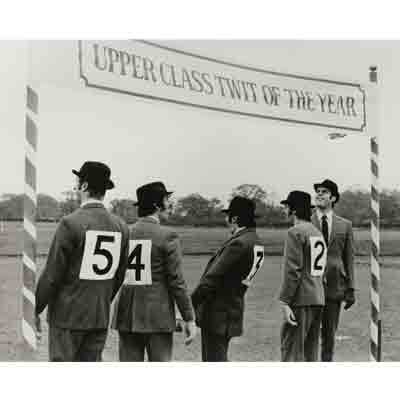
Oh, We Like Sheep...
Are brains shrinking to make us smarter?
February 6, 2011 by Jean-Louis SantiniHuman brains have shrunk over the past 30,000 years, puzzling scientists who argue it is not a sign we are growing dumber but that evolution is making the key motor leaner and more efficient.
The human mind, which can only be imperfectly represented, as a model, by an evolving, multiply connected Riemannian surface function, is conformable to a progressively less imperfect understanding of the inherent negative entropy of the universe. This concept of mind is what the age of Descartes referred to as "soul." His attempt to locate a physical connection to the soul in the pineal gland was as wrong headed, so to speak, as this quite non-sensical quibbling over the brain's size and intelligence. It is a simple school boy mistake to equate size with morphological complexity.
Sunday, February 06, 2011
Stellar Habitable Zones, Radiation and Circadian Rhythms
Astrobiologists theorize that conditions for life as we know it must be withins the bounds of an approximate conformal mapping to conditions upon our own home planet. Asking appropriate questions as to what precisely constitutes necessary such bounds seems to be paramount. One of the components that is putatively an invariant property of life is circadian rhythm. This rhythm is in evident quasi-coherence with the diurnal rotation of this planet. How would life change if the other necessary conditions were extant upon another habitable planet but instead of our speed of rotation there were a faster or slower one? Would this somehow impact how beneficent capture and utilization of stellar radiation is achieved by alien life forms? Indeed, what if we confirm some sort of capture of the radiative spectrum in an unfamiliar bandwidth and manner by some process or group of processes that evinces a separate and evolving organisation? Does this constitute life?


Thursday, February 03, 2011
Laputa Enamerado
Flash of fresh insight by electrical brain stimulation
February 2, 2011Are we on the verge of being able to stimulate the brain to see the world anew - an electric thinking cap? Research by Richard Chi and Allan Snyder from the Centre for the Mind at the University of Sydney suggests that this could be the case.
They found that participants who received electrical stimulation of the anterior temporal lobes were three times as likely to reach the fresh insight necessary to solve a difficult, unfamiliar problem than those in the control group. Thestudy published on February 2 in the open-access journal PLoS ONE.
According to the authors, our propensity to rigidly apply strategies and insights that have had previous success is a major bottleneck to making creative leaps in solving new problems. There is normally a cognitive tradeoff between the necessity of being fast at the familiar on one hand and being receptive to novelty on the other.
Chi and Snyder argue that we can modulate this tradeoff to our advantage by applying transcranial direct current stimulation (tDCS), a safe, non-invasive technique that temporarily increases or decreases excitability of populations of neurons. In particular, tDCS can be used to manipulate the competition between the left and right hemisphere by inhibiting and/or disinhibiting certain networks. Their findings are consistent with evidence that the right anterior temporal lobe is associated with insight or novel meaning and that inhibition of the left anterior temporal lobe can induce a cognitive style that is less top-down, less influenced by preconceptions.
This puts one in mind of nothing so much as Jonathan Swift's Journey to Laputa. There, the great scientists were so engrossed in abstract thinking that a servant with a blown up bladder with dried peas that rattled about in it, occasionally would flap these philosopher's mouths and ears. Thus, as is now confirmed by these brave researchers anew, some sort of external stimulation seems to be the key to creativity. Eureka! Let's get started right away. Jolly good show this. Eh what?

Sunday, January 30, 2011
Is the Multiverse Immoral?
This question of morality really belongs to the department of metaphysics. Leibniz soundly and cogently rejected the worldview that underlies the multiverse some 300 years ago. The rank pessimism of Voltaire’s Candide as a satirical response is echoed by today’s widely held “scientific” tenet that the fundamental law of the universe is irrationality. We meet this type of rather flagrant pessimism in this statement from Hawking: “But our genetic code still carries the selfish and aggressive instincts that were of survival advantage in the past.”
More Lilliputian Tales
"Real Time" host Bill Maher asked Rep. Jack Kingston (R-Ga.) a fairly straightforward question: "Do you believe in evolution?" Kingston not only said rejects the foundation of modern biology, he explained it this way: "I believe I came from God, not from a monkey." He added, "If it happened over millions and millions of years, there should be lots of fossil evidence."
Seriously, that's what he said.
Let's pause to appreciate the fact that it's the 21st century -- and Jack Kingston is a 10-term congressman who helps oversee federal funding on the Food and Drug Administration.
As part of the same discussion, former Canadian Prime Minister Kim Campbell tried to ask Kingston about the overuse of antibiotics. The far-right congressman had no idea how the question related to evolution.
At one point, Kingston, sarcastically, turned to National Review's Will Cain, part of the same roundtable, and said, "Will, help me out anytime you want, buddy."
The assumption, of course, is that Cain, a conservative, must agree with the confused congressman about modern science. Cain responded, "I'm sorry, I believe in evolution."
Will, you're not the one who should be sorry.
In the larger context, there's a renewed push underway for the United States to value and appreciate science in the 21st century -- our future depends on it. And while this push is underway, Republican leaders are more comfortable walking a bridge to the 18th century.
What an embarrassment.
This tired, phony debate that is so often trotted out is wrong on both sides...Liberals are constitutionally incapable of conceiving the difference between humanity and animals. They just adore the sentiment of John Lennon's charming lullaby: "Why don't we just do it on the road?" Pious Conservatives on the other hand are quite religious: they fervently worship one god...Mammon.
Saturday, January 29, 2011
Saturday Follies
Model predicts 'religiosity gene' will dominate society
(PhysOrg.com) -- In the past 20 years, the Amish population in the US has doubled, increasing from 123,000 in 1991 to 249,000 in 2010. The huge growth stems almost entirely from the religious culture’s high fertility rate, which is about 6 children per woman, on average. At this rate, the Amish population will reach 7 million by 2100 and 44 million by 2150. On the other hand, the growth may not continue if future generations of Amish choose to defect from the religion and if secular influences reduce the birth rate. In a new study, Robert Rowthorn, emeritus professor of economics at Cambridge University, has looked at the broader picture underlying this particular example: how will the high fertility rates of religious people throughout the world affect the future of human genetic evolution, and therefore the biological makeup of society?My model predicts increasing amounts of imbecilic "research" in order to inveigle grants from the suckers.
Thus saith the Lord: "Be fruitful and multiply (especially at those tent revivals!)"
Friday, January 28, 2011
Liberal Racism Exposed Liberally
January 27, 2011 by Helen Vesperini
(c) 2011 AFP
The pushing of this "appropriate technology" by Agence France Presse and Physorg.com is racist WWF crap. Franklin Roosevelt successfully implemented rural electrification 70 years ago in the United States!! The whole premise that Africa has a different culture than the west and we can't impose our values on them, is nothing more than a thinly disguised ruse for international finance to continue extracting resources cheaply from that continent unimpeded, i.e. loot them. The gullible mis-educated liberal that swallows this and similar propagandistic tripe is culpable in what is tantamount to deliberate genocide because they put the blinders of denial on whenever they are confronted with the glaring light of truth.
Evans Wadongo holds up one of his solar-powered LED lamps at his workshop in a Nairobi suburb. Not yet 25, Evans has already changed the lives of tens of thousands of his fellow Kenyans living in poor rural communities by supplying them with some 15,000 lamps since producing the first one from pieces of fabricated scrap metal and discarded solar equipment in 2004.
Evans Wadongo is not yet 25 but has already changed the lives of tens of thousands of his fellow Kenyans living in poor rural communities by supplying them with solar lamps.
As a child growing up in west Kenya, Wadongo struggled to do his homework by kerosene lamp. He was caned at school if his family ran out of fuel for the lamp, and he permanently damaged his eyesight by sitting over the smoky fumes when they did have kerosene.
But his father, whom he describes as a teacher who was "very strict" and "my greatest inspiration", saw that he completed his studies and made it into university.
Once there, Wadongo started wondering how to improve conditions for children in communities similar to his home village -- and there are many. Though Kenya is one of the richest countries in east Africa, more than half the population lives on less than a dollar a day.
The young man had always wanted to help people but did not have the stomach to go into medicine, so he opted for engineering. He was only 19 when he invented his first solar lamp after using part of his student loan to buy what he needed.
"Then, I never thought it would take off on this scale. I just wanted to take one to my grandma," he recalled.
Some 15,000 lamps have been turned out since production started in 2004, and Wadongo says his goal is to hit 100,000 by 2015.
"I started in the village where I grew up and I saw kids going from primary into high school," he told AFP.
He has no time for Kenya's political class, accusing them of "wanting people to remain poor so that they can stay in power".
For Wadongo, the lamps are not an end in themselves, but rather "a way to lift people out of poverty."

Jeniffer David, 47, hangs her solar-lamp outside her mud-brick house to get some sunlight at Chumbi village, some 50 kilometres southeast of Nairobi. David says the lamp has changed her family's life. Now, her children can read and study in the evening, without cost or nuisance.
He and his team from the "Use Solar, Save Lives" project start by identifying impoverished communities that rely for lighting on kerosene lamps -- when they can afford the fuel. They hand out 30 lamps to a community association, often a women's group, and encourage the locality to pool the money each family has saved by no longer buying kerosene.When the fund accumulates the group can use it for a project, such as fish farming or rabbit breeding.
Nomadic communities get a special model of lamp for easier transport.
Typical is Chumbi village, some 50 kilometres (31 miles) outside Nairobi where Wadongo gets an enthusiastic welcome.
"They all want lamps," smiles Agnes Muthengi, a representative from a local association, the Kalima Kathei Women's Fellowship, who accompanied him to the village.
Jennifer David, 47, lives in a mud-brick house flanked by outbuildings made largely from scrap metal.
Next door, a field of maize wilts for lack of water. David's husband is a casual day labourer and work is hard to come by. Her only other source of income is a fledgling rabbit breeding business. But with one rabbit only fetching the equivalent of one euro ($1.3) locally and one of the five children sick and in a home, life is a struggle.
A slogan painted on rusted corrugated iron informs the visitor that the inhabitants "trust in Jesus". Hanging on a post in the yard, one of Wadongo's lamps is charging.


A villager at Chumbi village, some 50 kilometres southeast of Nairobi, reads with the aid of a solar-powered lamp in her house. She is among the villagers in the east African country who have benfited from solar-powered LED lamps innovated by Kenyan Evans Wadongo.
"Since I got this lamp things have changed," David told AFP. "Before I was using kerosene. It smelled and gave off a lot of smoke and I was using a lot of money to buy the kerosene."Now, her children can read and study in the evening, without cost or nuisance.
Wadongo plans to extend his project to neighbouring countries -- Uganda is next on the list. He is already training interns, not only from Kenya and elsewhere in Africa but also from US universities. He also aims to decentralise production of the lamps, thus providing work for unemployed youths.
The young engineer is also planning a "model" village at Nyaobe in the west of this country, which straddles the equator. Residents will be hooked up to a local solar-powered grid and will have access to Internet.
"If every one of us started thinking about others before thinking about ourselves the world would be better," he says.
The pushing of this "appropriate technology" by Agence France Presse and Physorg.com is racist WWF crap. Franklin Roosevelt successfully implemented rural electrification 70 years ago in the United States!! The whole premise that Africa has a different culture than the west and we can't impose our values on them, is nothing more than a thinly disguised ruse for international finance to continue extracting resources cheaply from that continent unimpeded, i.e. loot them. The gullible mis-educated liberal that swallows this and similar propagandistic tripe is culpable in what is tantamount to deliberate genocide because they put the blinders of denial on whenever they are confronted with the glaring light of truth.
Sunday, January 23, 2011
A Heated Debate in Hell
The Reality of Death Panels
by Mike Stopa
SUPPORTERS OF President Obama’s health care reform law have relentlessly derided Sarah Palin’s notion of “death panels’’ as a vulgar rhetorical technique, with no basis in reality, devised merely to scare a gullible, uneducated citizenry into rallying to repeal the law. The death panel notion persists, however, because it denotes, in a pithy way, the economic realities of scarcity inherent in nationalizing a rapidly developing, high-technology industry on which people’s lives depend in a rather immediate way. G.K. Chesterton once wrote that vulgar notions (and jokes) invariably contain a “subtle and spiritual idea.’’ The subtle and spiritual idea behind “death panels’’ is that life-prolonging medical technology is an expensive, limited commodity and if the market doesn’t determine who gets it, someone else will.
In December, the Center for Medicare and Medicaid Services issued a regulation, since rescinded by the Obama administration, that would have allowed doctors to be reimbursed for “voluntary advanced care’’ planning. When the regulation was publicized, it resulted in a renewed outcry that such end-of-life planning provisions presage the inevitable death panels of ObamaCare.
In response, J. Donald Schumacher, president and CEO of the National Hospice and Palliative Care Organization, wrote in a CNN opinion piece that “an advance care planning consultation is not about limiting or rationing care. It’s not about hastening death. It’s not about having choices made for the patient. It’s not about saving money.’’
But anyone who thinks that end-of-life planning has nothing to do with cost has never had the unenviable experience of participating in that planning. According to Donald Berwick, the head of the Center for Medicare and Medicaid Services, “Using unwanted procedures in terminal illness is a form of assault. In economic terms, it is waste. Several techniques, including advance directives and involvement of patients and families in decision-making, have been shown to reduce inappropriate care at the end of life, leading to both lower cost and more humane care.’’
The resistance to incorporating end-of-life planning into Medicare is based on the rational fear that such planning will be used to coax patients into forgoing life-extending technologies that Medicare administrators may deem risky, of marginal benefit, or unlikely to succeed — an estimation that could be based in part on the cost of the technology.
Moreover, the suspicion that such programmed advance planning conceals ulterior motives is exacerbated by the fact that relatively few patients will ultimately benefit from it. It is mainly of value for those who do not die suddenly, who have no trustworthy relations to maintain their power of decision, and who lose their wits a potentially long time before their death.
Opposition to government-funded end-of-life planning does not imply ignorance of the indignity or discomfort of having one more tube placed into one’s body to buy an extra few days of painful life. (Although one can imagine concluding that dignity is a highly overrated virtue when the alternative is death). But when a massive government bureaucracy, tasked with determining medical “best practices’’ and controlling costs, announces a policy that “wellness visits’’ should have us chatting with our doctors about what technologically invasive, life-extending procedures we would just as happily do without, we are not supposed to be suspicious?
Even aside from end-of-life counseling, any form of medical insurance, including ObamaCare, has to determine where the boundaries of coverage lie. Today, hospitals decide not to provide life-extending procedures all the time. In practice, for those who have no independent means, some form of utilitarian, “greatest good for greatest number’’ ethic is imposed whereby treatment is approved based on things like the likelihood of success and the potential lifespan of the patient. Much of the rigor of those considerations is already envisioned as part of the Patient-Centered Outcomes Research Institute.
Conversely, medical technology is forever inventing new medicines and procedures that have the potential to extend life or cure the previously incurable. Each such technique inevitably passes through a phase where it is experimental, risky, and expensive. Often enough the sky is the limit and so late in life we are all liable to become, in the words of the late Harvard philosopher Robert Nozick, “utility monsters.’’
To the extent that ObamaCare ultimately succeeds in imposing uniformity on basic health care, it will likely lead to the creation of secondary markets for providing insurance against various health eventualities and access to “heroic’’ procedures to extend life. Water runs downhill and it’s a good thing that it does. First, we need to have people buy the expensive medicines and experimental technologies. Europe has discovered this as its regulated system of medicine has driven its pharmaceutical industry farther and farther behind that of the United States. Capping costs kills innovation.
But, in addition, Palin is right. Death panels are an inevitable consequence of socialized medicine. The law of scarcity demands them.
A mature discussion of health care must recognize basic economics so that we can think ahead on how to satisfy the demands of those who are not satisfied with base-level care.
Saturday, January 22, 2011
More Chaotic Babble
Viz, what passes for professional linguistics these days! Perhaps its savantry...When Heine attacked the political Chaoten in his day, little did he imagine that they would emerge as such garrulous scientific types. Wilhelm Von Humboldt said the measure of a language is its ability to enhance intellectual capabilities of its speakers. Here and now our post moderns will turn poor Humboldt on his head! Hey presto! What marvelous meretricious palaverous blather is this? They know not whereof they speak...
"Human languages evolve continuously, and a puzzling problem is how to reconcile the apparent robustness of most of the deep linguistic structures we use with the evidence that they undergo possibly slow, yet ceaseless, changes. Is the state in which we observe languages today closer to what would be a dynamical attractor with statistically stationary properties or rather closer to a non-steady state slowly evolving in time? Here we address this question in the framework of the emergence of shared linguistic categories in a population of individuals interacting through language games. The observed emerging asymptotic categorization, which has been previously tested - with success - against experimental data from human languages, corresponds to a metastable state where global shifts are always possible but progressively more unlikely and the response properties depend on the age of the system. This aging mechanism exhibits striking quantitative analogies to what is observed in the statistical mechanics of glassy systems. We argue that this can be a general scenario in language dynamics where shared linguistic conventions would not emerge as attractors, but rather as metastable states."
"Human languages evolve continuously, and a puzzling problem is how to reconcile the apparent robustness of most of the deep linguistic structures we use with the evidence that they undergo possibly slow, yet ceaseless, changes. Is the state in which we observe languages today closer to what would be a dynamical attractor with statistically stationary properties or rather closer to a non-steady state slowly evolving in time? Here we address this question in the framework of the emergence of shared linguistic categories in a population of individuals interacting through language games. The observed emerging asymptotic categorization, which has been previously tested - with success - against experimental data from human languages, corresponds to a metastable state where global shifts are always possible but progressively more unlikely and the response properties depend on the age of the system. This aging mechanism exhibits striking quantitative analogies to what is observed in the statistical mechanics of glassy systems. We argue that this can be a general scenario in language dynamics where shared linguistic conventions would not emerge as attractors, but rather as metastable states."
From the Mouths of Babes
Fool's gold catches eye of solar energy researchers
January 21, 2011 By Tiffany HsuIron pyrite - also known as fool's gold - may be worthless to treasure hunters, but it could become a bonanza to the solar industry. The mineral, among the most abundant in the earth's crust, is usually discarded by coal miners or sold as nuggets in novelty stores.
I must whole heartedly agree: solar energy research is indeed comparable to fool's gold.
Now Isn't This a Dainty Quantum Dish?
Quantum robins lead the way
January 21, 2011 by Pete Wilton
European robin. Photo: Wikimedia/Erik Vikne.
(PhysOrg.com) -- Did you know that the humble robin uses quantum physics?
Researchers have been investigating the mechanism which enables birds to detect the Earth's magnetic field to help them navigate over vast distances. This ability, known as magnetoreception, has been linked to chemical reactions inside birds' eyes.
Now a team from Oxford University and Singapore believe that this 'compass' is making use of something called quantum coherence.
In a forthcoming article in Physical Review Letters the team report how they anaylsed data from an experiment by Oxford and Frankfurt scientists on robins.
The experiment showed that the magnetic compass used by robins could be distrupted by extremely small levels of magnetic 'noise'. When this noise, a tiny oscillating magnetic field, was introduced it completely disabled the Robins' compass sense which then returned to normal once the noise was removed - good news for robins which have to navigate on the long migration route to Scandinavia and Africa and back every year.
In their analysis the Oxford/Singapore team show that only a system with components operating at a quantum level would be this sensitive to such a small amount of noise.
'Quantum information technology is a field of physics aimed at harnessing some of the deepest phenomena in physics to create wholly new forms of technology, such as computers and communication systems,' said Erik Gauger of Oxford University's Department of Materials, an author of the paper.
'Progress in this area is proving to be very difficult because the phenomena that must be harnessed are extremely delicate. It would normally be thought almost inconceivable that a living organism could have evolved similar capabilities.'
Co-author Simon Benjamin from Singapore explained: 'Coherent quantum states decay very rapidly, so that the challenge is to hold on to them for as long as possible. The molecular structures in the bird's compass can evidently keep these states alive for at least 100 microseconds, probably much longer.'
'While this sounds like a short time, the best comparable artificial molecules can only manage 80 microseconds at room temperature. And that's in ideal laboratory conditions.'
Erik and Simon now hope that further research into how birds harness these quantum states could enable researchers to mimic them and help in the development of practical quantum technologies.
Thank You Bill Gates for Your "Charity"
Pathological Video Game Use Among Youths: A
Two-Year Longitudinal Study
RESULTS: The prevalence of pathological gaming was similar to that in
other countries ( 9%). Greater amounts of gaming, lower social competence, and greater impulsivity seemed to act as risk factors for
becoming pathological gamers, whereas depression, anxiety, social
phobias, and lower school performance seemed to act as outcomes of
pathological gaming.
CONCLUSION: This study adds important information to the discussion
about whether video game “addiction” is similar to other addictive
behaviors, demonstrating that it can last for years and is not solely a
symptom of comorbid disorders. Pediatrics 2011;127:e319–e32
Two-Year Longitudinal Study
RESULTS: The prevalence of pathological gaming was similar to that in
other countries ( 9%). Greater amounts of gaming, lower social competence, and greater impulsivity seemed to act as risk factors for
becoming pathological gamers, whereas depression, anxiety, social
phobias, and lower school performance seemed to act as outcomes of
pathological gaming.
CONCLUSION: This study adds important information to the discussion
about whether video game “addiction” is similar to other addictive
behaviors, demonstrating that it can last for years and is not solely a
symptom of comorbid disorders. Pediatrics 2011;127:e319–e32
Subscribe to:
Posts (Atom)