Today's Elites

Thursday, March 31, 2011

DNA is more intelligent than Einstein's enemies

It appears that contrary to Mr Heisenberg's qualms about the know-ability of the quantum world, DNA is quite able to choose the quantum spin it reacts with. Providing once again more evidence for appropriate animadversion to the methods of statistical mechanistic empircism.To wit:

Biological Molecules Select Their Spin
02 Apr
2011
Quantum Physics

New findings could help build better biomedical devices

Do the principles of quantum mechanics apply to biological systems? Until now, says Prof. Ron Naaman of the Institute’s Chemical Physics Department (Faculty of Chemistry), both biologists and physicists have considered quantum systems and biological molecules to be like apples and oranges. But research he conducted together with scientists in Germany, which appeared recently in Science, definitively shows that a biological molecule – DNA – can discern between quantum states known as spin.

Quantum phenomena, it is generally agreed, take place in extremely tiny systems – single atoms, for instance, or very small molecules. To investigate them, scientists must usually cool their material down to temperatures approaching absolute zero. Once such a system exceeds a certain size or temperature, its quantum properties collapse, and “every day” classical physics takes over. Naaman: “Biological molecules are quite large, and they work at temperatures that are much warmer than the temperatures at which most quantum physics experiments are conducted. One would expect that the quantum phenomenon of spin, which exists in two opposing states, would be scrambled in these molecules – and thus irrelevant to their function.”

But biological molecules have another property: they are chiral. In other words, they exist in either “left-” or “right-handed” forms that can’t be superimposed on one another. Double-stranded DNA molecules are doubly chiral – both in the arrangement of the individual strands and in the direction of the helices’ twist. Naaman knew from previous studies that some chiral molecules can interact in different ways with the two different spins. Together with Prof. Zeev Vager of the Particle Physics and Astrophysics Department, research student Tal Markus, and Prof. Helmut Zacharias and his research team at the University of Münster, Germany, he set out to discover whether DNA might show some spin-selective properties.

The researchers fabricated self-assembling, single layers of DNA attached to a gold substrate. They then exposed the DNA to mixed groups of electrons with both directions of spin. Indeed, the team’s results surpassed expectations: The biological molecules reacted strongly with the electrons carrying one of those spins, and hardly at all with the others. The longer the molecule, the more efficient it was at choosing electrons with the desired spin, while single strands and damaged bits of DNA did not exhibit this property. These findings imply that the ability to pick and choose electrons with a particular spin stems from the chiral nature of the DNA molecule, which somehow “sets the preference” for the spin of electrons moving through it.

In fact, says Naaman, DNA turns out to be a superb “spin filter,” and the team’s findings could have relevance for both biomedical research and the field of spintronics. If further studies, for instance, bear out the finding that DNA only sustains damage from spins pointing in one direction, then exposure might be reduced and medical devices designed accordingly. On the other hand, DNA and other biological molecules could become a central feature of new types of spintronic devices, which will work on particle spin rather than electric charge, as they do today.
Prof. Ron Naaman is head of the Nancy and Stephen Grand Research Center for Sensors and Security, and his research is supported by Rachel Schwartz, Canada. Prof. Naaman is the incumbent of the Aryeh and Mintzi Katzman Professorial Chair.

Sunday, March 13, 2011

The Cat's Out Again

 “The human toll here,” Larry Kudlow declared, “looks to be much worse than the economic toll and we can be grateful for that.” 


Question for Mr Kudlow: How did you calculate the loss of human life? In yen or dollars? The bailing out of the vast pyramid of gambling debt from the city of London and Wall Street that is currently costing untold human suffering throughout the globe should, I think, make Ludlow and his ilk smile to themselves considerably...

Saturday, March 12, 2011

Amazing True Stories

"Some respond to Japan earthquake by pointing to global warming"


This shocking news just in: Loss of gray matter proven to be caused by global warming!

Cui Bono?

"Speaking at Cambridge Science Festival next week, Professor Ed Bullmore will describe how new ways of looking at the network organisation of the human brain show that it has a surprising amount in common with the worm brain, computer chips, stock markets, and many other complex systems."


Apparently, by some remarkably ironic twist of fate, Professor Bullmore has the most apropos appellation that anyone might possibly imagine.

A Brilliant Bit of Hypothesizing

Bravo! This bit of astounding detective work certainly has the ring of truth to it. By combining two principles which are prevalent in all classes of biota,viz: least action and asymmetry, these researchers have broken new scientific ground. This builds upon the rigorous touchstone work of Louis Pasteur and provides further evidence to the overarching rule of biophysical hypothesis formation resulting from the premise that that which distinguishes the organic from the inorganic spheres is critical.


Nanotubes: Cellular membranes on supply

March 11, 2011
Nanotubes: cellular membranes on supply
Nanotube formation in a vesicle containing two droplets (PEG - dark, and dextran - green). The membrane is labelled in red. After deflation of the vesicle, nanotubes form within the PEG-rich phase and accumulate at the interface between the two droplets. (a-c) Vertical cross sections of the vesicle; (d) top view of the nanotubes located at the interface. © Max Planck Institute of Colloids and Interfaces
(PhysOrg.com) -- When unfolding a tent for the first time, you may wonder how the huge tarpaulin fits into a bag the size of a football. Biologists wonder about something similar: when a cell divides, the surface area of the cell membrane grows. Moreover, when molecules are brought from one organelle to another inside the cell, membrane-enclosed transport vesicles are formed. So that membranes can be made available quickly, they are stored within the cells in the form of nanotubes, tubular membrane structures – similarly to a tarpaulin that has been folded together. Researchers at the Max Planck Institute of Colloids and Interfaces in Potsdam have now discovered a mechanism used by cells to generate stable membrane nanotubes.
free DIY solar Power PDF - make your own solar panels and save a fortune. Free 'how to' PDF - www.DIYsolarpowerPDF.com
Tubular membrane structures can be found in many areas of a cell: in the Golgi apparatus, a type of sorting station in which transport vesicles are formed; in the mitochondria, the power plants of the cell; or in the endoplasmic reticulum, a type of duct network within cells. The tubes have a diameter ranging from a few nanometres (one millionth of a millimetre) to a few micrometres (one thousandth of a millimetre). The thinner the tubes, the greater the surface to volume ratio. They are therefore ideal for storing a lot of membrane in rather small spaces. Researchers believe that  can use energy to pull  from cellular membranes. “However, motor proteins are not always found in the areas of the cell where membrane nanotubes are formed,” says Rumiana Dimova, a researcher at the Max Planck Institute of Colloids and Interfaces and co-author of the study. For this reason, she believes that there must be another mechanism to generate stable nanotubes.
The Potsdam-based researchers may have now found the answer to the riddle. “The mechanism generates stable nanotubes without forces having to be exerted on the membrane. It therefore seems to work without the need for motor proteins,” says Dimova. Part of the mechanism is based on a phenomenon that is omnipresent in the world of membranes, the so-called osmosis. If certain molecules are present in a larger concentration outside the cell than inside the cell – i.e. they form a so-called hypertonic solution – then water will flow out of the cell and the cell will contract.
The researchers in Potsdam have reproduced such concentration differences using artificial vesicles the size of a cell, which contain a mixture of two polymers, namely polyethylene glycol (PEG) and dextran. “Biopolymers are found in a similarly high concentration in living cells,” says Dimova. “For this reason, we consider the vesicle to be a good model of a cell.” The researchers transferred the vesicle to a hypertonic solution, which caused the vesicle to release water and to shrink in volume.
However, what happened was completely different to a scenario in which, for instance, a beach ball is deflated and then simply collapses into a flat pancake. The outflow of the water caused the concentration of the dissolved polymers in the vesicle to rise. This, in turn, caused the two polymers to separate. As a result, two separate droplets of different sizes formed in the vesicle, much like the shape of a snowman with one large sphere (mainly containing PEG molecules) and one smaller sphere (predominantly containing dextran molecules).
Using a fluorescence microscope, the Potsdam-based researchers observed that membrane nanotubes formed in the PEG-rich area and accumulated at the interface between the two droplets. The scientists showed that about 15 % of the membrane surface had been stored in the tubes. The resolution of the microscope was not sufficient to be able to determine the diameter of the tubes. However, the researchers estimate it to be about 240 nanometres.
The researchers also have an explanatory model for the emergence and stability of the nanotubes. They found that solution flows of different densities are triggered when the polymers are separated. These exert forces on the membrane and thus contribute to the formation of the tubes.
The next question the scientists asked was what causes the membrane tubes to remain stable. A theoretical analysis of the observed membrane shapes revealed that stable tubes only emerge if the two sides of the membrane have an asymmetrical, molecular structure. This asymmetry is caused by the interaction between the membrane and the biopolymers. There is a high concentration of PEG molecules on one side, whereas on the other side there are no such molecules. Because the PEG interacts with the lipid  within the membrane, the membrane attempts to curve inwards. The formation of nanotubes accommodates this behaviour of the cellular membrane. The researchers observed that the nanotubes disappear again if the vesicle is allowed to inflate once again through osmosis.
“For natural cells, it is easy to generate asymmetry – similarly to what we have seen in our experiment,” says Dimova. The bio-physicist therefore believes that the newly discovered mechanism could be used in living  to store the membrane surface. However, proof of this is still pending.
More information: Yanhong Li, Reinhard Lipowsky, Rumiana Dimova, Membrane nanotubes induced by aqueous phase separation and stabilized by spontaneous curvature, PNAS; DOI:10.1073/pnas.1015892108
Provided by Max-Planck-Gesellschaft (news : web)

Saturday, March 05, 2011

Woo, woo

LSE director quits over Libya links


Oh my word. It looks like Sir Davies (if that is what he is) had taken the title of a song of another graduate of the wretched London School of Economics Mick Jagger too much to heart. I refer of course to Sympathy for the Devil... Bully!


(By the Bye. One mustn't forget the cozy relation that the British upper crust always seems to have with many other assorted nasties in that neck of the desert. Viz: the Al Yamamah- BAE scandal which they have so meticulous­ly covered up for state security reasons, you understand­. And don't forget that the same tattered excuse was used to cover up the "suicided" David Kelly who was exposing Blair's skull- duggery. Etc., etc.)

Sherrod Brown apologizes for Hitler comment

Alas, cowardice in the face of an enemy...
One would hope that more Democrats start coming to their senses and throw off this delusion of not wanting to hurt these bullies' self esteem by aptly characterizing them as Sherrod Brown has done. The question is when will they start aptly characterizing Obama as nothing but Wall Street's cats-paw at best and their useful idiot more pointedly?

Saturday, February 26, 2011

How Barack Obama Is A Traitor to the Unique Mission of the United States

One may not utter the words in the title of this writing lightly. It is only with a comprehensive understanding of why the mission of these United States in world history necessarily calls upon our nation's chosen President to lead the globe out of its current unfolding existential crisis, that the full force of the charge of treachery is truthfully justified. It has been a providential endowment nearly miraculous that the idea embodied in our constitution that the nation exists in order to benefit the future well being of its citizens both materially and otherwise that absolutely separates us apart from the long succession of failures of governments in history. That overarching principle places the responsibility upon our shoulders to rise above the degradation that has been imposed on us over the years since we acted to pull the world away from the doom of a lasting dark age had we not prevailed in last century's World War II. However, the immoral compromise we made as a people beginning with Truman's monstrous relegation and undermining of this nation's mission instead to abjectly subserve as an instrument of an intended banker's dictatorship for world government has put us and the planet in grave peril at the moment of this writing.

It is unfortunate that for most of my fellow citizens these foregoing words will fall on deaf ears. Edgar Alan Poe, who was truly one of the most patriotic writers we have yet produced, said of the biography of Washington by James Kirke Paulding:

"We have read Mr. Paulding’s Life of Washington with a degree of interest seldom excited in us by the perusal of any book whatever. We are convinced by a deliberate examination of the design, manner, and rich material of the work, that, as it grows in age, it will grow in the estimation of our countrymen, and, finally, will not fail to take a deeper hold upon the public mind, and upon the public affections, than any work upon the same subject, or of a similar nature, which has been yet written — or, possibly, which may be written hereafter. Indeed, we cannot perceive the necessity of anything farther upon the great theme of Washington. Mr. Paulding has completely and most beautifully filled the vacuum which the works of Marshall and Sparks have left open. He has painted the boy, the man, the husband, and the Christian. He has introduced us to the private affections, aspirations, and charities of that hero whose affections of all affections were the most serene, whose aspirations the most God-like, and whose charities the most gentle and pure. He has taken us abroad with the patriot-farmer in his rambles about his homestead. He has seated us in his study and shown us the warrior-christian in unobtrusive communion with his God. He has done all this too, and more, in a simple and quiet manner, in a manner peculiarly his own, and which mainly because it is his own, cannot fail to be exceedingly effective. Yet it is very possible that the public may, for many years to come, overlook the rare merits of a work whose want of arrogant assumption is so little in keeping with the usages of the day, and whose striking simplicity and naiveté of manner give, to a cursory examination, so little evidence of the labor of composition. We have no fears, however, for the future. Such books as these before us, go down to posterity like rich wines, with a certainty of being more valued as they go. They force themselves with the gradual but rapidly accumulating power of strong wedges into the hearts and understandings of a community."


Reading this unfortunately forgotten tome, it becomes immediately evident that Paulding conveyed the unique mission of America embodied in the life of George Washington as a complete and singular experiment upon which the future of humanity rested then and now.  I urge you, dear reader to take this volume up. You will be none the worse for it.


Returning to the purpose, we are now come to a worldwide upheaval and conflagration that is the direct result of Obama's abject kowtowing to the orders of City of London and its junior partners on Wall Street. The only way out of the impending spiral of global immiseration and chaos is to throw off the yoke of our historic enemy, the British empire. It is in this light, that we justly charge the minions, Obama being chief among them, of this crumbling financial empire with treachery. LaRouche has authored a solution to the sorry years of compromise we as a nation have made with this evil. It is high time we rose to the occasion and adopt it.

Friday, February 25, 2011

Wormholes

This just in:


"Stars Could Have Wormholes At Their Cores, Say Astrophysicists

Far from being links between empty regions of space, wormholes could form shortcuts from one star to another"

I can't really say whether stars might have wormholes in them, but I think that this particular research proves beyond a doubt that we should look for holes in certain astrophysicists' heads. Thanks for your kind consideration.

Wednesday, February 23, 2011

The Utterly Ineffable Imbecility of Academia on Parade:

Responses to the Assurance game in monkeys, apes, and humans using equivalent procedures

Abstract


There is great interest in the evolution of economic behavior. In typical studies, species are asked to play one of a series of economic games, derived from game theory, and their responses are compared. The advantage of this approach is the relative level of consistency and control that emerges from the games themselves; however, in the typical experiment, procedures and conditions differ widely, particularly between humans and other species. Thus, in the current study, we investigated how three primate species, capuchin monkeys, chimpanzees, and humans, played the Assurance (or Stag Hunt) game using procedures that were, to the best of our ability, the same across species, particularly with respect to training and pretesting. Our goal was to determine what, if any, differences existed in the ways in which these species made decisions in this game. We hypothesized differences along phylogenetic lines, which we found. However, the species were more similar than might be expected. In particular, humans who played using “nonhuman primate-friendly” rules did not behave as is typical. Thus, we find evidence for similarity in decision-making processes across the order Primates. These results indicate that such comparative studies are possible and, moreover, that in any comparison rating species’ relative abilities, extreme care must be taken in ensuring that one species does not have an advantage over the others due to methodological procedures.


(Although this seems like a spoof, perhaps from the pages of The Onion, it is verbatim from the horses' mouths. Honest.)


    Saturday, February 19, 2011

    Growing Evidence That "Information" Models of Biophysics Are Dead Wrong

    Two recent research papers point our attention toward disproving the assumptions underlying information theory's intrusion upon biophysics, inter alia. Before discussing these recent developments, it must be mentioned that prima facie information theory from its onset has always rankled many, including myself, on the grounds of its dehumanizing ontological implications. The crass mechanistic and reductionist empiricism evident in Wiener's doctrine of "cybernetics" provides a paradigm for this modern revamping of Occam's razor. Humanists in the line from Plato to Leibniz have quite naturally always been viscerally repulsed by such "thinking." 


    It is therefore, with great pleasure that we must hail any results that tend to undermine such a hideous and anti-human ideology. Whenever experimental results deviate from these sorts of assumptions, we realize that the original meaning of hypothesis in the Platonic sense of a method of questioning metaphysical assumptions is a universally truthful standard for scientific method in perpetuity. 


    The first paper, "Slow integration leads to persistent action potential firing in distal axons of coupled interneurons," released in December on the transmission of action potential current in axons in the opposite direction away from dendrites and back into the neurons is a remarkable take-down of the whole idea of transmission of some imagined computer-like "bits" of information in the circuitry of the brain. The second paper, "Molecular vibration-sensing component in Drosophila melanogaster olfaction," published just this week seriously undermines the lock and key model of chemical signalling in protein recognition. It further further concludes that this model must be replaced by a vibrational wave sensing model. It turns out that fruit flies can distinguish the "smell" of the deuterium isotope, which as far as the chemical lock and key model of sensation should be no different from the protium isotope of hydrogen. This bears upon this author's longstanding preference for a biophysics that highlights persistent, chiral solitonic waveforms that differentiate our living biosphere. It is in certain such unique conformations of the inert and apparently"dead" lithosphere that we find the substrate that life exhibits an immanent capability to choose. These types of investigations are increasingly crucial for the field of astrobiology, the which will predominate as mankind moves out to colonize space if the oligarchical Malthusian, Aristotelean information theory worldview is given a well deserved burial.

    Thursday, February 17, 2011

    Shocking New Global Warming Study: Impact on Genetic Psychology Examined

    Public Release: 16-Feb-2011
     Global Change Biology
    Global warming may reroute evolution
    Rising carbon dioxide levels associated with global warming may affect interactions between plants and the insects that eat them, altering the course of plant evolution, research at the University of Michigan suggests. 
     National Science Foundation

    More news on this front  just in:

    The University of Grantland has just issued an earth shattering study on global warming. It now appears that global warming has caused a mutation in the human genome. The left side of the orbitofrontal cortex in a range of  human subjects has been impaired by a deletion of a gene that controls the urge to gamble. It turns out that this deletion somehow selectively affects the global warming deniers. They apparently fail to accept proven scientific global warming studies because they have a compulsion to take risks with the future of the earth's climate. Researchers from Grantland are now preparing a course of remedial therapy for those subjects so affected. It appears that an intensive course of deep brain stimulation given over several months cures this neurological aberration. The only drawback seems to be a side effect; the test subjects are prone to excessive grinning, clishmaclaver, and compulsive drawing of happy faces.

    Saturday, February 12, 2011

    Barack Obama, Rand Paul: Useful Idiots

     Both the Republican and Democratic administrations have pandered to and bailed out Wall Street's insane gambling spree to the tune of trillions, and now they want the people to buy this tripe? It is beyond disgusting and revolting. Appropriate words to describe the level of treachery to the nation's future are hard to come by. Dante's Inferno comes to mind...All those who provide cover for the looting of the people by international financial institutions, whether they be "liberal" or "conservative" deserve only opprobrium.  The Financial Crisis Inquiry Report of Angelides has it right, we are making the same mistakes on an even larger scale now by bailing out these thieves, while they go merrily on their way continuing their evil practices. Their is no real substantive difference when you come right down to it between Barack Obama and Rand Paul, except in their rivalry to cater more effectively to Wall Street. They are the equivalent of today's useful idiots.

    Wednesday, February 09, 2011

    Today's Sun and Moon Worshipers Like the Aztecs Lead Only to Death for Humanity

    The Lunar Cubit could merge art and solar power

    February 8, 2011 by Katie GattoThe Lunar Cubit could merge art and solar power
    (PhysOrg.com) -- An ancient form may be coming to the modern world. A new project, called the Lunar Cubit, features a set of nine black pyramid-shaped solar powered structured. The structures will power thousands of homes in the Abu Dhabi desert. Each of the pyramids would be able to provide power to about 250 desert homes. This instillation may not be powerful as a standard solar power farm, but it would be visually stunning.


    The question now before us is just this: will these irrational, Luddite sun worshipers now reveal their true colors and revert to the overt practice of human sacrifice in the tradition that their anti-science, pagan and bestial ideology promotes. 

    Monday, February 07, 2011

    Twits Like Us


    The Virtual Twitterverse That Can Forecast The Real Thing

    Researchers have built a synthetic network that can recreate the behaviour of Twitterverse
    KFC 02/07/2011

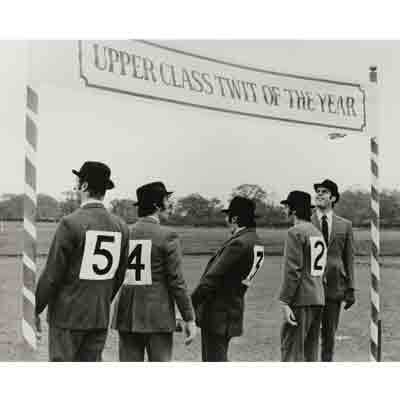
    May I modestly suggest that there is no need to go to all this computational trouble in order to get an accurate model of the so called Twitterverse. All one needs do is simply study the excellent representations of the goings on of Twits on the old Monty Python television broadcasts. Of course, one must take care so as not to conflate the behavior of said Twits with one's own research methodology. That might bias the results somewhat...

    Oh, We Like Sheep...

    Are brains shrinking to make us smarter?

    February 6, 2011 by Jean-Louis Santini
    Human brains have shrunk over the past 30,000 years, puzzling scientists who argue it is not a sign we are growing dumber but that evolution is making the key motor leaner and more efficient.

    The human mind, which can only be imperfectly represented, as a model, by an evolving, multiply connected Riemannian surface function, is conformable to a progressively less imperfect understanding of the inherent negative entropy of the universe. This concept of mind is what the age of Descartes referred to as "soul." His attempt to locate a physical connection to the soul in the pineal gland was as wrong headed, so to speak, as this quite non-sensical quibbling over the brain's size and intelligence. It is a simple school boy mistake to equate size with morphological complexity.

    Sunday, February 06, 2011

    Stellar Habitable Zones, Radiation and Circadian Rhythms

    Astrobiologists theorize that conditions for life as we know it must be withins the bounds of an approximate conformal mapping to conditions upon our own home planet.  Asking appropriate questions as to what precisely constitutes necessary such bounds seems to be paramount. One of the components that is putatively an invariant property of life is circadian rhythm. This rhythm is in evident quasi-coherence with the diurnal rotation of this planet. How would life change if  the other necessary conditions were extant upon another habitable planet but instead of  our speed of rotation there were a faster or slower one? Would this somehow impact how beneficent capture and utilization of stellar radiation is achieved by alien life forms? Indeed, what if we confirm some sort of capture of the radiative spectrum in an unfamiliar bandwidth and manner by some process or group of processes that evinces a separate and evolving organisation? Does this constitute life?


    Thursday, February 03, 2011

    Laputa Enamerado

    Flash of fresh insight by electrical brain stimulation

    February 2, 2011
    Are we on the verge of being able to stimulate the brain to see the world anew - an electric thinking cap? Research by Richard Chi and Allan Snyder from the Centre for the Mind at the University of Sydney suggests that this could be the case.

    They found that participants who received  of the anterior temporal lobes were three times as likely to reach the fresh insight necessary to solve a difficult, unfamiliar problem than those in the control group. Thestudy published on February 2 in the open-access journal .
    According to the authors, our propensity to rigidly apply strategies and insights that have had previous success is a major bottleneck to making creative leaps in solving new problems. There is normally a cognitive tradeoff between the necessity of being fast at the familiar on one hand and being receptive to novelty on the other.
    Chi and Snyder argue that we can modulate this tradeoff to our advantage by applying transcranial direct current stimulation (tDCS), a safe, non-invasive technique that temporarily increases or decreases excitability of populations of neurons. In particular, tDCS can be used to manipulate the competition between the left and right hemisphere by inhibiting and/or disinhibiting certain networks. Their findings are consistent with evidence that the right anterior temporal lobe is associated with insight or novel meaning and that inhibition of the left anterior temporal lobe can induce a cognitive style that is less top-down, less influenced by preconceptions.
    While further studies involving  in combination with are needed to elucidate the exact mechanisms leading to insight, Chi and Snyder can imagine a future when non-invasive brain stimulation is briefly employed for solving problems that have evaded traditional cognitive approaches.

    This puts one in mind of nothing so much as Jonathan Swift's Journey to Laputa. There, the great scientists were so engrossed in abstract thinking that a servant with a blown up bladder with dried peas that rattled about in it, occasionally would flap these philosopher's mouths and ears. Thus, as is now confirmed by these brave researchers anew, some sort of external stimulation seems to be the key  to creativity. Eureka! Let's get started right away. Jolly good show this. Eh what?

    Sunday, January 30, 2011

    Is the Multiverse Immoral?

    This question of morality really belongs to the department of metaphysics. Leibniz soundly and cogently rejected the worldview that underlies the multiverse some 300 years ago. The rank pessimism of Voltaire’s Candide as a satirical response is echoed by today’s widely held “scientific” tenet that the fundamental law of the universe is irrationality. We meet this type of rather flagrant pessimism in this statement from Hawking: “But our genetic code still carries the selfish and aggressive instincts that were of survival advantage in the past.”

    More Lilliputian Tales

    "Real Time" host Bill Maher asked Rep. Jack Kingston (R-Ga.) a fairly straightforward question: "Do you believe in evolution?" Kingston not only said rejects the foundation of modern biology, he explained it this way: "I believe I came from God, not from a monkey." He added, "If it happened over millions and millions of years, there should be lots of fossil evidence."
    Seriously, that's what he said.
    Let's pause to appreciate the fact that it's the 21st century -- and Jack Kingston is a 10-term congressman who helps oversee federal funding on the Food and Drug Administration.
    As part of the same discussion, former Canadian Prime Minister Kim Campbell tried to ask Kingston about the overuse of antibiotics. The far-right congressman had no idea how the question related to evolution.
    At one point, Kingston, sarcastically, turned to National Review's Will Cain, part of the same roundtable, and said, "Will, help me out anytime you want, buddy."
    The assumption, of course, is that Cain, a conservative, must agree with the confused congressman about modern science. Cain responded, "I'm sorry, I believe in evolution."
    Will, you're not the one who should be sorry.
    In the larger context, there's a renewed push underway for the United States to value and appreciate science in the 21st century -- our future depends on it. And while this push is underway, Republican leaders are more comfortable walking a bridge to the 18th century.
    What an embarrassment.

    This tired, phony debate that is so often trotted out is wrong on both sides...Liberals are constitutionally incapable of conceiving the difference between humanity and animals. They just adore the sentiment of John Lennon's charming lullaby: "Why don't we just do it on the road?" Pious Conservatives on the other hand are quite religious: they fervently worship one god...Mammon.

    Blog Archive